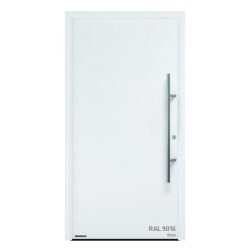











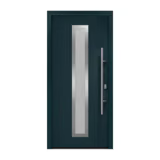




Forcing open doors or windows accounts for the vast majority of burglaries. We cannot claim our home is secure unless our doors and windows are secure too. For the safety of its customers, Hörmann supplies entrance doors that meet the RC2 and RC3 resistance class standards.

RESISTANCE TO </br> STATIC LOADING (EN 1628)
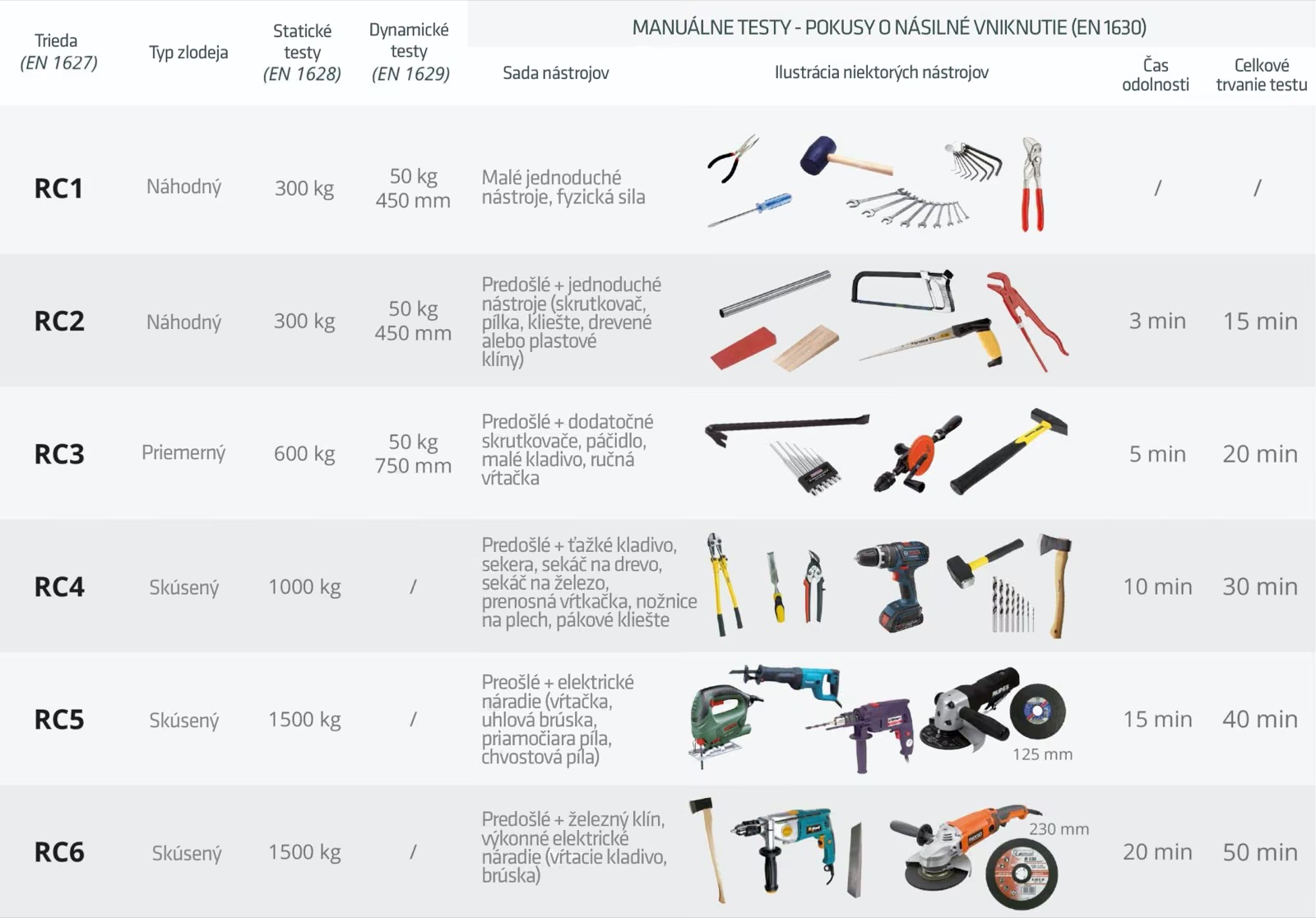
All reinforced points of the door (corners, the hardware area and the pins) are subjected to a force applied by a machine. This load is 3 kN for classes 1 and 2, 6 kN for class 3, 10 kN for class 4 and 15 kN for classes 5 and 6. To give you an idea, 10 kN corresponds roughly to a load of 1,020 kg. The door must not deform.
RESISTANCE TO </br> DYNAMIC LOADING (EN 1629)
Resistance to dynamic loading is assessed by dropping a 50 kg body onto three load points. For classes 1 and 2 the drop height is 450 mm; for class 3 it is 750 mm. For class 4 and above, the standard specifies no dynamic loading tests, as resistance to static loading is very high and sufficient. A condition for passing the test is that the door leaf remains flat.
RESISTANCE TO MANUAL </br> BURGLARY ATTEMPTS (EN 1630)
The results are assessed by the tools used, which are what matter most here. The standard describes the tools (force, instruments, duration, etc.) used to make an opening of at least the defined dimensions. The test is passed if, within the specified time, the template objects (a rectangle, an ellipse and a circle) cannot pass through any openings that may have been made during the test. During this test the attackers are given a different set of tools for each class.
A resistance class is the ability to withstand forced entry into a protected space using physical force or tools. The latest burglary resistance regulations (EN 1627, EN 1628, EN 1629 and EN 1630) establish a new classification using the abbreviation RC (Resistance Class). It replaces the previous standard, which used the abbreviation WK (from the German Widerstandsklasse, resistance class). The following information table compares the individual classes of the new classification and briefly describes the methods of break-in:
Resistance classes and values